'What I Did' - Script Editor
- gabbottabbott

- May 21, 2019
- 2 min read
At the beginning of our 3rd and final year studying at the University of Brighton, one module demanded that we be assigned two job roles for our peers’ projects, as a method of expanding and honing our skills.
For my first role, it was decided that I would act as a script editor for course-mate and friend Leanne Dixon’s final project. I, of course, jumped at the opportunity, feeling confident in my skills due to having successfully co-written for our 2nd year short film Missing, as well as a few smaller, personal projects.
This is not to say that the task was boring or too easy. In fact, with the director opting for the format of a radio play, it was rather challenging and definitely interesting. Unlike audio-visual content, you are unable to simply show-and-tell an audience - at least not in quite the same way. What would initially be visual, is instead replaced with carefully chosen soundscapes; familiar sounds woven throughout to spark an image in the listeners mind.
Therefore, it was crucial that the chosen storyline incorporated locations and settings easily identifiable through sound iconography.
I feel this was achieved well with the final product, due to it taking place in a police station, primarily within a holding cell - there are certain sounds we can automatically associate with this place, such as heavy, metal doors, echoing footsteps, jangling keys...etc.
Before going ahead with the aforementioned idea, the director and I would spit-ball ideas at eachother via messenger, hoping that together we could work out a doable yet still interesting plot.


As you can see, one of our early ideas was much more intricate and complicated, requiring far too much character development and establishing for a radio play that should ideally only last up to 20 minutes; according to Jeremy Page, a BBC 4 National Short Story Award nominee.
When it came to actually editing the finished script, I had to take care to focus on the actions and noises performed by the characters(s), as opposed to their expressions and/or thoughts, as I instinctively wanted.

I also had to be wary where dialogue was concerned. As an avid writer of fiction myself, I believe dialogue to be incredibly important - I want readers to be immersed and remain so, not feel unable to relate to a character due to a poor choice of words. It is no news that real people curse and stutter and repeat, so I felt that needed to be included. Luckily, I didn’t feel the need to alter much of the original script in that aspect, as the director’s own dialogue seemed perfectly raw and human.
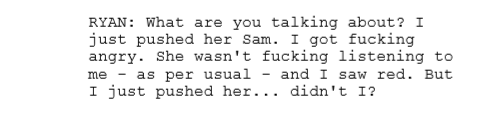
Additionally on the subject of dialogue, I appreciate that the director allowed actors to ad-lib and offer their own takes on scenes, as it led to the character interaction and dynamics being far more natural.

Comments